
Why Your Messy Journal Entry Is Smarter Than You Think
We spend all day pretending we know what's going to happen. Your journal is the one place where you can admit you don't - and that's where the real thinking starts.
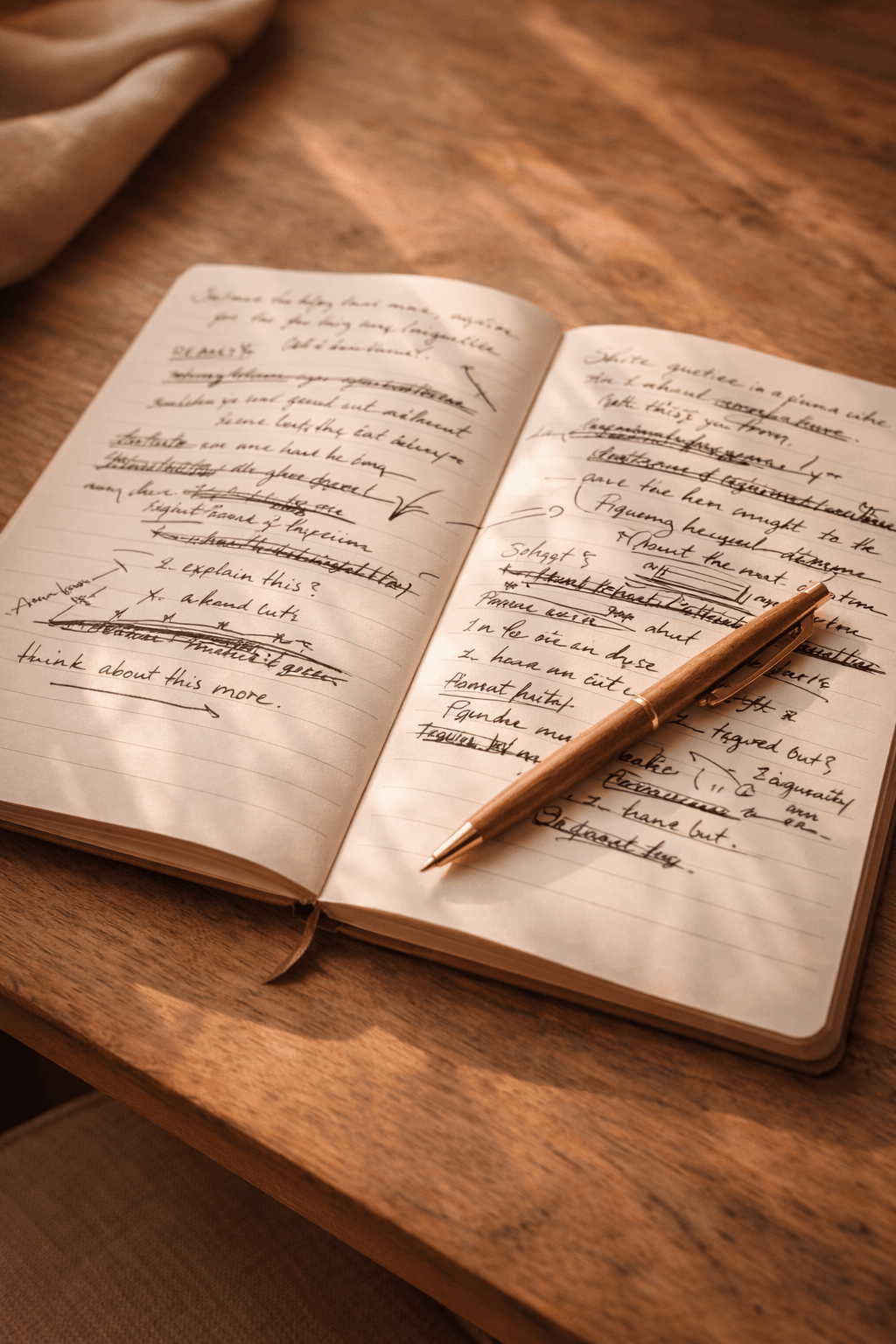
I used to think the point of journaling was to organize my thoughts. Sit down, write clearly, come out the other side with a neat little insight wrapped in a bow.
That's not what happens. At least not for me.
Most days, what comes out is half-formed. Run-on sentences. Contradictions. I'll start writing about a decision I'm stuck on and end up three paragraphs deep into something I didn't even know was bothering me. It feels messy. It feels like I'm doing it wrong.
Turns out, that's the whole point.
The illusion of knowing
There's this idea from Nassim Taleb - the guy who wrote The Black Swan - that we massively overestimate how much we understand about what's happening around us. He calls it the "narrative fallacy." We take random, chaotic events and stitch them into clean stories after the fact, then convince ourselves we saw it coming all along.
We do this constantly. At work: "I knew that project was going to fail." In relationships: "I had a feeling something was off." With money: "I should have sold earlier."
No, you didn't know. Neither did I. We just hate admitting that most of life is uncertain, so we retrofit explanations onto things that already happened.
Here's why this matters for journaling: your journal is the one place where you can catch yourself doing this in real time.
Writing before you "know"
The most valuable journal entries I've written are the ones where I didn't have a conclusion. Where I just dumped what I was actually thinking - the doubt, the conflicting impulses, the "I have no idea what to do here."
That's not a sign of confused writing. That's honest writing.
When you sit down and write "I think I should take this job but something feels off and I can't tell if that's intuition or just fear of change" - that one messy sentence is doing more cognitive work than a week of pretending you've got it figured out. You're acknowledging uncertainty instead of papering over it.
And that changes how you make decisions. Not because the journal gives you answers, but because it stops you from faking answers you don't have.
The stuff that shows up sideways
There's another thing that happens when you write without a plan. Stuff sneaks in.
I'll be writing about my workday and suddenly I'm writing about my dad. I'll be listing what I'm grateful for and realize I keep mentioning the same friend - the one I haven't called in months. I'll be journaling about a trade I made and halfway through I'll notice I'm actually writing about control, and how bad I am at letting go of it.
None of that would surface in a "top 3 things I'm grateful for" template. It shows up because the writing was messy enough to let it through.
Taleb has this concept of "optionality" - putting yourself in positions where you can benefit from randomness and surprise. I think unstructured journaling is the mental health version of that. You're creating space for unexpected insight. You're not forcing a narrative. You're letting one emerge.
Sometimes nothing emerges, and that's fine too. You just wrote for ten minutes and none of it was profound. That's still ten minutes where you were honest with yourself instead of performing for an audience.
You don't need a system (but a small one helps)
I'm not anti-structure. I track my mood. I try to write every day, even if it's just a few sentences. I have a word count goal, and seeing a streak build does motivate me in a simple, almost embarrassing way.
But the structure is just the container. What goes inside is allowed to be chaos.
If you're someone who's been putting off journaling because you think you need to do morning pages, or bullet journaling, or some specific gratitude framework - you don't. You need a blank page and permission to write badly.
The "badly" part is actually the feature. When you write without performing, without editing yourself, without trying to sound insightful - that's when you get the real stuff. The stuff your brain has been chewing on underneath all the noise.
What I actually do
Since people always ask: I open my journal, I write the date, and I start typing whatever's in my head. Sometimes it's about a problem I'm working through. Sometimes it's just "I'm tired and I don't feel like writing but here I am."
I track my mood with a simple 1-5 scale because over time it shows me patterns I'd otherwise miss. Not daily patterns - those are noise. But when I look at a month and see that my mood consistently dips on Sundays, or that my best weeks correlate with weeks I exercised, that's signal.
Some days I use a prompt because staring at a blank page isn't working. Some days I write 800 words. Some days I write 60. The 60-word days count just as much.
The only rule I actually follow: don't go back and edit yesterday's entry. It's supposed to be a snapshot, not a draft. Let it be imperfect. Let it be wrong. Future you will read it and learn something from the gap between what you thought then and what you know now.
That gap? That's growth. And you can only see it if you let the messy version exist.
The uncomfortable truth about clarity
Here's the thing nobody tells you about journaling: clarity doesn't feel like clarity when it's happening. It feels like rambling. It feels like going in circles. It feels like writing the same worry for the fourth time this week.
And then one day you're writing it again and you realize - oh, I already know what I need to do about this. I've known for a while. I just wasn't ready.
That's the journal doing its work. Not by solving the problem, but by keeping you in contact with it long enough for your own mind to get there.
You can't think your way to that kind of clarity. You have to write your way to it. Messily. Imperfectly. Without knowing where it's going.
Just like everything else that matters.
Your messy thoughts deserve a home. Start writing with DayGrid - it's free, and there's no wrong way to use it.
Ready to start writing?
DayGrid is free, takes 30 seconds to set up, and you can start with just one sentence.
Start Writing Free