
The Two-Minute Rule That Made All My Other Habits Click
I tried building habits with spreadsheets, streak apps, and sheer willpower. What actually worked was so simple I almost didn't notice it happening.

I have a confession. Over the past three years, I've downloaded at least a dozen habit tracking apps. I've built spreadsheets with conditional formatting so elaborate they looked like mission control. I once created a color-coded wall calendar system that required four different highlighters and a ruler.

None of it stuck.
Not the morning routines I copied from podcasts. Not the "21 days to build a habit" challenges. Not even the accountability partner I recruited (sorry, Dave). Every system I tried shared the same fatal flaw: they all assumed I was the kind of person who could maintain a complicated system. I am not that person. You're probably not either. And that's fine, because the thing that actually changed my habits wasn't a system at all. It was a two-minute journal entry.
The Accidental Discovery
Here's what happened. About six months ago, I started writing in a journal. Not because I had a grand plan for self-improvement. I was just stressed, and someone told me that getting thoughts out of your head and onto a page could help. So one morning, I sat down and wrote for about two minutes. Nothing profound. Something like: "Slept terribly. Skipped the gym again. Feeling like a bag of sand."
That was it. Two minutes. Maybe forty words.
The next morning, I did it again. Not because I was disciplined, but because it was so low-effort that there was no real reason not to. And on day three, something small but important happened: I wrote "Skipped the gym again" for the second time, and I felt something. Not guilt exactly. More like... recognition. Like reading your own handwriting from yesterday forced a kind of honesty that thinking alone never did.
On day four, I went to the gym.

Why Writing It Down Changes the Game
There's a concept in behavioral science called an "anchor habit." It's the idea that certain habits, once established, create a ripple effect that makes other habits easier to adopt. Exercise is a classic example. People who start working out regularly often find themselves eating better, sleeping better, and drinking less, even if they never consciously decided to change those things.
Journaling, it turns out, might be the most underrated anchor habit there is.
Here's why. Most habits fail because of a gap between intention and awareness. You intend to drink more water, but you don't actually notice how little you're drinking until you have a headache at 3 PM. You intend to go to bed earlier, but you don't register the pattern of late-night scrolling until you're three weeks deep into sleep deprivation.
A journal entry closes that gap. Not because it forces you to change. Because it forces you to see.
When you write "Stayed up until 1 AM again" three days in a row, you can't pretend it was a one-time thing. When you write "Ate takeout for the fourth night this week," you've turned a vague feeling into a concrete fact. And concrete facts are much harder to ignore than abstract intentions.
The Two-Minute Framework
I want to be careful here, because the last thing the world needs is another overcomplicated journaling method with an acronym. So let me keep this painfully simple.
The framework is this: write for two minutes every morning. That's it.
No prompts. No structure. No minimum word count. Just open the page (or app) and write whatever comes to mind. If all you write is "I'm tired and I don't want to do this," that counts. If you write three paragraphs about a dream you had, that counts too.
The only rule is two minutes. Set a timer if you need to. When it goes off, you can stop. You can also keep going. Most days, you'll find you want to keep going. But even on the days you don't, you've done the thing. And doing the thing, even badly, is what makes it stick.
What Two Minutes Actually Buys You
Here's what I didn't expect. After about three weeks of two-minute journal entries, I started noticing patterns I'd been blind to for years.
The sleep pattern. I kept writing about being exhausted. When I scrolled back through a week of entries, I realized every "exhausted" day followed a night where I'd been on my phone past midnight. I didn't need a sleep tracker to tell me this. I needed to read my own words.
The exercise pattern. On days I exercised, my journal entries were noticeably different in tone. More energy, more ideas, fewer complaints. I didn't set out to prove that exercise improves mood. The journal proved it for me, using my own data.
The social pattern. This one surprised me. I noticed that my worst days (mood-wise) almost always followed days with zero social interaction outside of work meetings. Not zero human contact, but zero non-transactional conversation. The kind of thing you'd never notice unless you were writing it down.
None of these insights required fancy analytics or AI-powered dashboards. They came from the simple act of reading my own two-minute entries back to back.
The Domino Effect
Once you start seeing patterns, something shifts. You stop trying to build habits through willpower and start building them through awareness. And awareness, unlike willpower, doesn't run out at 4 PM.
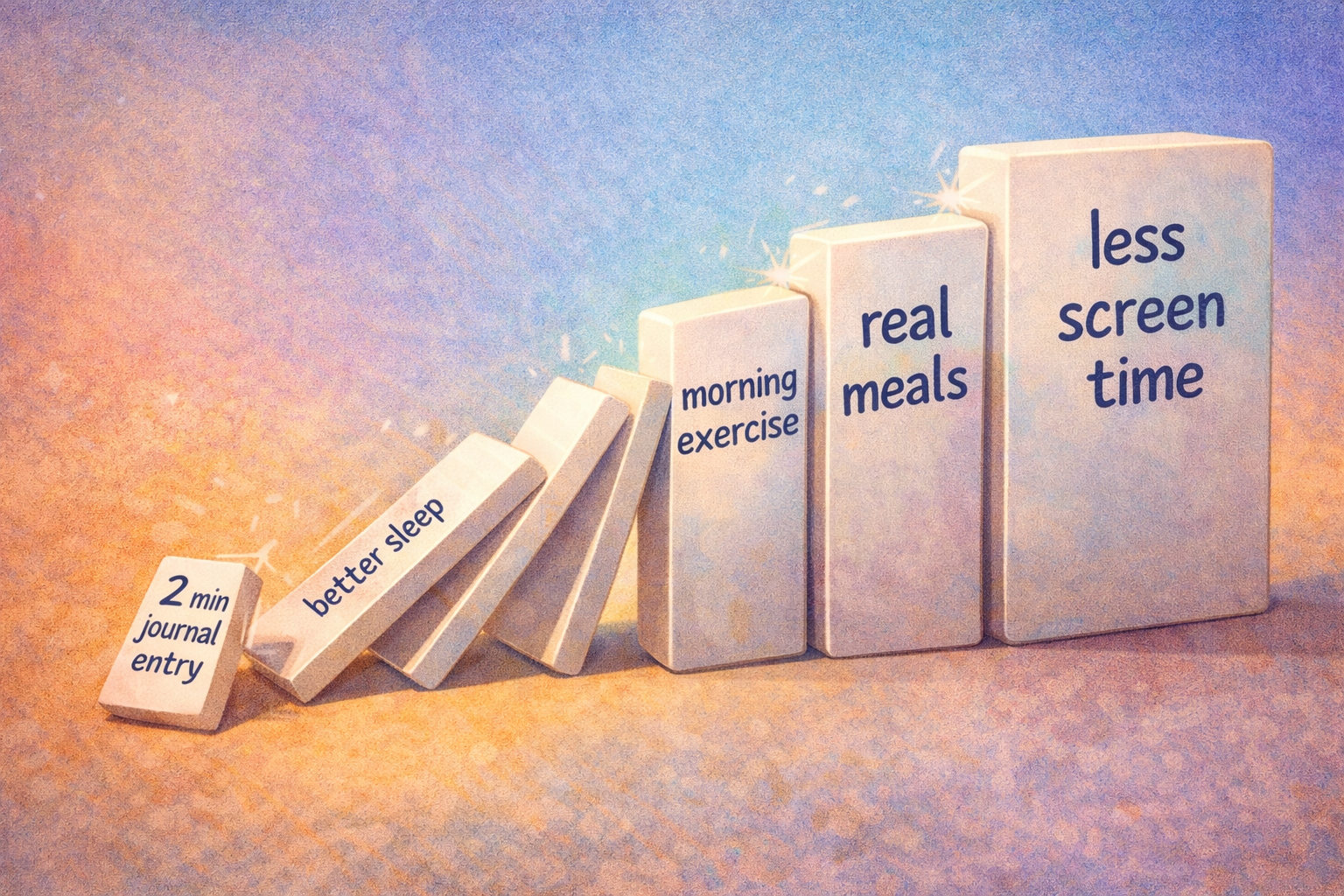
Here's how the domino effect worked for me:
The journal showed me I was sleeping badly. So I started putting my phone in another room at 11 PM. That wasn't a "habit I decided to build." It was a direct response to something I could see in my own writing.
Better sleep meant I actually woke up when my alarm went off. Which meant I had time to run in the morning. Which meant I felt better by 9 AM. Which meant I ate a real lunch instead of grabbing whatever was fastest. Which meant I had more energy in the afternoon. Which meant I wasn't doomscrolling at midnight to decompress.
One domino. Two minutes.
I'm not saying journaling magically fixed everything. I still have bad days, still skip runs, still eat garbage sometimes. But the difference is that now I can see it happening in real time instead of looking back months later and wondering where things went sideways.
"But I Don't Know What to Write"
This is the objection I hear most often, and I get it. Staring at a blank page with no prompt feels like being asked to perform.
So here's a cheat: just answer one question. Pick whichever one you'd actually answer honestly.
"How do I feel right now?" works. So does "What am I avoiding today?" or "What's one thing I noticed yesterday?" You don't need to answer all three. You don't even need to answer in complete sentences. "Tired. Stressed about the project. Wish I'd gone for a walk." That's a journal entry. That's enough.
The goal isn't beautiful writing. The goal is a breadcrumb trail. Something you can look back on in a week and use to connect dots your brain was too busy to connect in the moment.
Start Smaller Than You Think You Should
If there's one thing I've learned from all my failed habit experiments, it's this: the habits that stick are the ones that feel almost too easy to bother with. Two minutes of writing feels like nothing. That's exactly why it works. It slides under the radar of your inner resistance. There's no part of your brain that can argue against two minutes.
And once you've done it for a week, you'll start to notice things. Once you notice things, you'll start to change things. Not because someone told you to. Because you told yourself, in your own words, on your own page.
That's the trick. The two-minute journal entry isn't really about journaling. It's about giving yourself a daily window of honesty. And honesty, it turns out, is the only habit tracker you actually need.

DayGrid makes it easy to build a two-minute journaling habit with daily entries, mood tracking, and simple habit tracking that actually fits your life. No spreadsheets or highlighters required. Start writing for free.
Ready to start writing?
DayGrid is free, takes 30 seconds to set up, and you can start with just one sentence.
Start Writing Free